Cake Maker: Kids Cooking Games
- 4.4
- Rating
- 10.00M
- Installs
- Free
- Price

 Analysis by App-foxy
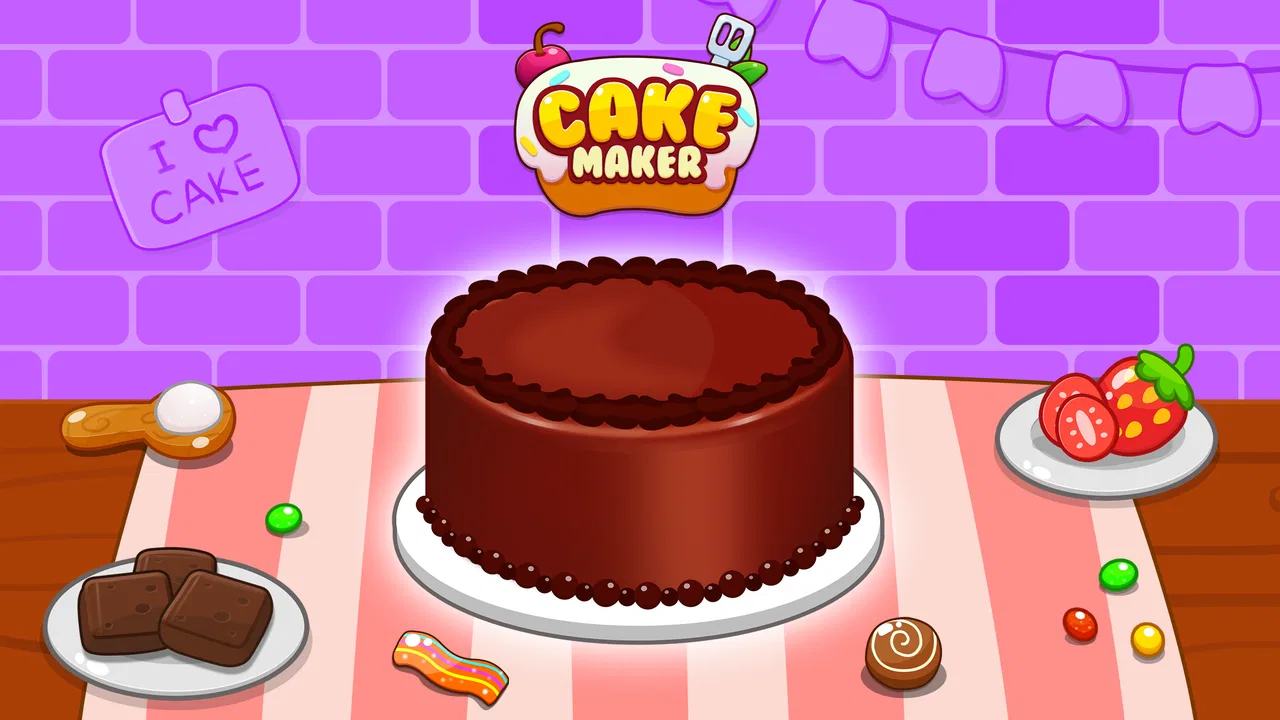
I tried Cake Maker: Kids Cooking Games with one question in mind: is it genuinely useful for a young child who wants to “bake,” or is it just a very short distraction? My answer is fairly positive, with an important qualification. This is a focused, gentle role-playing game built around decorating and preparing chocolate cakes, not a broad cooking simulator. That narrow focus is exactly why it can work well for toddlers, but it also means older children may outgrow it quickly.
The game comes from Piggy Panda Inc and is free to install. It is listed for Everyone, which matches the simple, non-threatening presentation I experienced. The basic appeal is immediate: a child can enter a cake-making world, choose actions connected with baking, and spend time decorating the result. There is no need to understand a complicated story or learn a large set of controls before getting started.
I would describe it as a screen-time activity for very young children rather than a serious cooking lesson. It can encourage recognition of colors, shapes, and sequences, but parents should not expect accurate kitchen instruction. The fun comes from the process and the visual result, not from reproducing a real recipe.
You May Also Like

 Blood Strike: 2.5 Anniversary
Blood Strike’s Loadouts Turn Every Drop Into a Tactical Gamble
A close look at Blood Strike’s custom loadouts: how fast access to signature weapons reshapes its battle royale rhythm, rewards preparation, and narrows the gap between fights.

 Pandora - Music & Podcasts
Pandora’s Music Is Easy to Start, but Harder to Recover
Pandora’s strength is its low-effort path from a seed to a station. Its weak spot is how much confidence it asks you to place in connection, setup, and quiet recovery.

 8 Ball Pool
 Is Built on Rivalries, Rematches, and Routine
A close look at the rivalries, rematches, shared routines, and unanswered safety questions that turn a quick pool match into a persistent mobile community.

 Samsung Music
’s Quiet Strength Is Playing What You Already Own
Its reach comes less from spectacle than from dependable access to a personal library. That simplicity is both the app’s strongest retention engine and its ceiling.

 AccuWeather: Weather Radar
AccuWeather Review: A Quick, Clear Forecast for Everyday Decisions
For everyday plans, the best forecast is the one you can understand quickly. AccuWeather makes rain timing, radar, and local conditions easy to act on, with a few trade-offs.

 Hill Climb Racing
Why Hill Climb Racing Still Turns Crashes Into One More Run
A tiny car, a bumpy hill and one more upgrade: Hill Climb Racing keeps resurfacing because its simple chaos makes every near-miss feel personal.
More From Our News Desk
View All News


How I Decided Whether It Was Worth Keeping
I judge whether a children’s game deserves a place on a device by looking beyond the first burst of curiosity: does the child return to it, and does the play still feel worthwhile once the controls are familiar? I also consider whether a parent can keep sessions purposeful without turning them into a lesson. That gives me a practical way to weigh its lasting value against its simplicity.
The right question is age, not ambition
When I review a children’s game like this, I first look at whether its actions are understandable without constant adult translation. Cake Maker has a clear central theme, and that helps. A child who already enjoys pretend cooking can grasp the purpose quickly because the game stays close to a familiar activity: making something sweet and adding decoration.
That simplicity is a strength for toddlers. A complicated role-playing game may offer more content, but it can also create frustration through menus, reading, timed tasks, or rules that are difficult to explain. Here, the child can focus on the imaginative part. I found that the game is best suited to short sessions in which a parent is nearby at the beginning, then allows the child to explore independently once the basic flow makes sense.
It is also worth separating pretend play from learning claims. The game may support hand-eye coordination and encourage a child to notice differences between decorative choices, but it should not replace actual cooking experiences. If your goal is to teach kitchen safety, measuring, heat, or food preparation, a real supervised activity or a more educational cooking app would be a better fit.
What makes the format approachable
The cake theme gives the experience a natural beginning and end. A child starts with the idea of preparing a cake and finishes with something decorated. That sense of completion matters more than it might seem. Open-ended creative apps can be enjoyable, but some young children do better when an activity has a recognizable goal.
I also like that the concept does not depend on reading ability. For a pre-reader, an app that relies heavily on written instructions can turn into a guessing exercise. Cake Maker’s appeal is more visual and tactile, so an adult can explain the first interaction in everyday language and let the child take over. This makes it a reasonable choice for a waiting room, a quiet afternoon, or a brief activity before bedtime, provided the device is being used in a way the family is comfortable with.
One practical tip is to play the first session together rather than handing over the phone immediately. Watch what the child understands without help. If the child can identify the main action and enjoys choosing decorations, the game is probably a comfortable match. If the child repeatedly taps without understanding what changed, a simpler drawing or matching game may offer a better first experience.
Where it fits among children’s cooking games
Compared with broad cooking games, this one feels more approachable because it does not ask a toddler to manage a whole restaurant or juggle several dishes. Restaurant-style alternatives can be better for children who enjoy planning, multitasking, and longer progression systems. They may also hold the attention of older children for longer, but they often introduce more pressure and more rules.
Compared with open-ended art apps, Cake Maker provides a stronger pretend-play frame. A drawing app gives a child more freedom, while this game gives the child a recognizable activity to imitate. I would choose the cake game for a child who wants to act out baking and choose an art app for a child who mainly wants to experiment with colors and shapes without a defined outcome.
There is another useful comparison with educational cooking apps. Those products may be preferable when the family wants explicit explanations, recipe structure, or lessons connected to real-world food preparation. Cake Maker is lighter and easier to enter, but its value is primarily imaginative. That is not a flaw; it simply changes what “good” means here.
Where this game wins
The strongest part of the experience is its focused theme. Instead of presenting a crowded collection of unrelated mini-games, it gives the child one familiar fantasy and lets that fantasy carry the session. For a toddler, fewer choices can actually feel more inviting. The child is not required to decide which of many modes to learn first.
The visual reward of completing a cake is another advantage. Young children often enjoy seeing a clear transformation from an unfinished item into a decorated one. That result can encourage them to try again with different choices, even when the underlying activity is simple. I found this more engaging than games where the child performs actions but receives no visible creative result.
The best use is a short, shared play session that gradually becomes independent pretend play. An adult can ask the child to describe the cake, name colors, or explain which decoration they prefer. Those conversations add value that the app itself cannot provide. They also prevent the activity from becoming passive tapping.
A less obvious benefit is that the cake theme can be used as a transition activity. For example, before helping with a real birthday preparation, a child can play briefly and then move to a safe task such as choosing napkins or placing decorations under supervision. The game does not teach those practical steps directly, but it can make the idea of baking feel familiar and exciting.
Small habits that make the experience better
I recommend treating each completed cake as a prompt rather than rushing straight into another round. Ask the child what they changed, what they would do differently, or who the cake is for. This turns a repetitive loop into storytelling. It also helps reveal whether the child is enjoying creative choice or merely following taps.
Another useful approach is to let the child choose the theme of the session before opening the game: a birthday cake, a pretend cake for a toy, or a cake for the family. Even if the game does not provide those exact scenarios, the child can supply the story. This is a simple way to add imaginative depth without pretending the app contains features it does not have.
For a child who becomes frustrated easily, avoid correcting every choice. The point is not to produce a realistic cake. Let the child make unusual combinations and talk about them afterward. If the child wants more challenge, the adult can introduce a verbal sequence such as “first we prepare, then we decorate,” while keeping the on-screen activity relaxed.
Limitations I noticed
The same focus that makes the game welcoming can make it feel limited. A child who wants a cooking career fantasy, a restaurant challenge, or a large collection of recipes may find the cake-only concept too narrow. I would not choose it as the only game on a tablet for a school-age child who expects complex goals and long-term progression.
Repetition is another consideration. Once a child understands the basic cake-making rhythm, the novelty may depend heavily on how much they enjoy decorating and replaying the same kind of activity. That is perfectly acceptable for a toddler’s brief session, but it is less convincing for children seeking variety. Parents should judge the game as a focused toy, not as an all-purpose cooking world.
In-app purchases are listed at $1.99 per item. Because the game is aimed at young children, I would handle installation and purchasing settings myself and avoid leaving a child alone with a payment-capable device. The free entry is convenient, but any family considering optional purchases should decide in advance what is acceptable rather than making that decision during play.
The game launched on February 19, 2024, and the current version is 2.8. It requires Android 8.0 or later. Those details matter when choosing an older hand-me-down phone or tablet. Before planning to use it on a child’s device, I would check the operating system and make sure the device has enough general space and battery for comfortable play.
Who should choose an alternative
I would steer families toward a different category if the child dislikes pretend cooking or needs a stronger educational structure. A puzzle game may be more suitable for a child who enjoys problem-solving, while a drawing app may be better for a child who wants complete control over the canvas. A cooking game with broader tasks may win for children who are ready to follow several steps and manage more decisions.
It may also be the wrong choice for parents looking for a quiet, low-interaction activity that teaches real recipes. Cake Maker works best when an adult occasionally joins the conversation. Without that involvement, the game can become a sequence of taps with less imaginative value. That is not unique to this title, but it is especially relevant because its mechanics are intentionally simple.
Families should also consider how often the child wants to replay the same theme. If the answer is “only once,” the free installation still makes it easy to test, but the app may not deserve a permanent place on the home screen. If the child repeatedly asks to decorate cakes and enjoys inventing stories around them, the narrow scope becomes a benefit rather than a weakness.
What switching to another game really involves
Moving from Cake Maker to another children’s game is easy in technical terms, but the experience can change more than expected. A broader alternative may offer more content while demanding more patience, more reading, or more adult explanation. Before switching, I would identify the actual problem: is the child bored with cake decorating, confused by the controls, or simply ready for a new kind of play?
If boredom is the issue, try adding a real-world conversation or a supervised kitchen follow-up before uninstalling. If confusion is the issue, play alongside the child and reduce the number of instructions you give at once. If the child wants challenge, then a broader role-playing or cooking title may genuinely be the better next step.
There is also a cost to switching in terms of familiarity. A toddler who already understands this game may enjoy the independence that comes from knowing what to do. A new app can be richer but may require another learning period. For occasional use, that trade-off is minor. For a child who uses the game as a calming routine, familiar simplicity may be more valuable than extra features.
My recommendation for families
I recommend Cake Maker: Kids Cooking Games to parents of toddlers who enjoy colorful pretend play and need a straightforward activity with a clear cake-making theme. Its Everyone rating, free entry, and gentle role-playing format make it easy to try, while the focused design keeps the first session understandable. Piggy Panda Inc has chosen a narrow idea, and in this age group that can be a sensible design decision.
I would recommend it less strongly for older children, serious cooking learners, or anyone expecting a deep simulation. Those users will probably get more from a broader cooking game, a structured educational app, or a creative tool with fewer limits. The game is not trying to be all of those things, and judging it by that standard would be unfair.
With an average rating of 4.1 from around 7.8 thousand ratings and more than 10 million installs, it has clearly reached a substantial audience, though popularity alone is not a reason to install it. My own deciding factor is simpler: does the child enjoy repeating a small pretend-baking routine and making choices about the finished cake?
If yes, this is a pleasant free option for short sessions, especially when an adult turns the result into a conversation or a bridge to safe real-world play. If no, do not force it because the theme sounds educational. Choose a game that matches the child’s preferred kind of interaction. For the right toddler, Cake Maker is charming and accessible; for everyone else, its limited scope becomes visible quickly.
FAQs for Cake Maker: Kids Cooking Games
01What age group is Cake Maker: Kids Cooking Games suitable for?
Cake Maker: Kids Cooking Games is designed primarily for children aged 4 to 12. The game features simple controls and colorful graphics that make it easy for young players to engage with the cooking activities. However, it can also be enjoyable for anyone who loves creative cooking games.
02Does Cake Maker: Kids Cooking Games require an internet connection?
No, Cake Maker: Kids Cooking Games does not require an internet connection to play. This makes it perfect for entertaining children during travel or in areas without Wi-Fi. However, certain features, like updates or in-game purchases, might require internet access.
03Are there any in-app purchases in Cake Maker: Kids Cooking Games?
Yes, Cake Maker: Kids Cooking Games includes optional in-app purchases. These might offer additional cake designs, decorations, or tools to enhance the game experience. It's advisable for parents to manage these settings to prevent unintended purchases by children.
04Is Cake Maker: Kids Cooking Games available on both Android and iOS devices?
Yes, Cake Maker: Kids Cooking Games is available for download on both Android and iOS devices. Users can find it on Google Play Store and Apple App Store, ensuring compatibility with a wide range of smartphones and tablets.
05How does Cake Maker: Kids Cooking Games encourage creativity?
The game allows kids to design and decorate their unique cakes using a variety of ingredients and tools. This freedom encourages creativity and imagination, as children experiment with colors, shapes, and decorations to create their perfect cake, fostering artistic expression and decision-making skills.
Pros
- Intuitive controls for easy gameplay.
- Wide variety of cake recipes available.
- Engaging graphics attract young players.
- Educational elements in cooking steps.
- Frequent updates with new content.
Cons
- Contains ads that can be distracting.
- In-app purchases for full features.
- Limited free content without purchases.
- Requires internet for some features.
- May not challenge older kids.

Cake Maker: Kids Cooking Games
Gallery